
XMoon/dsh-pi-tui
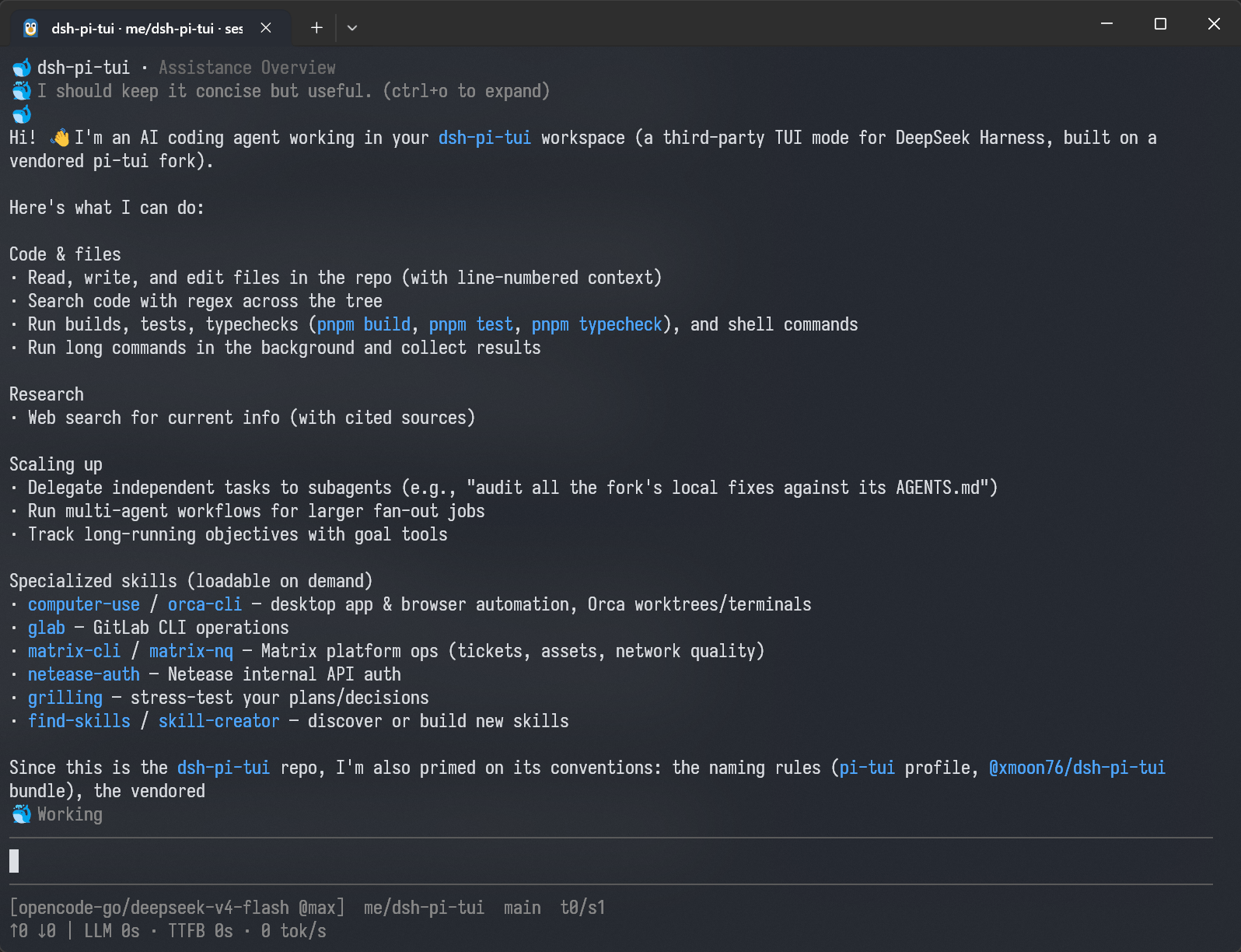
A third-party TUI mode for DeepSeek Harness (dsh), built on a vendored fork of pi-tui
これは DeepSeek Harness(DSH)プラグインです。当サイトは GitHub README、インストール情報、メンテナンス状況、公開セキュリティシグナルをまとめています。
上流で中国語 README が提供されていないため、リポジトリのオリジナルコンテンツを表示しています。
dsh-pi-tui
A third-party TUI mode for DeepSeek Harness (dsh), built on a vendored fork of pi-tui.
Run dsh --profile pi-tui for a terminal UI instead of the browser GUI (dsh --profile web) or one-shot mode (dsh --profile headless).
Status: working. The TUI covers the main session loop — input → session events, approvals, commands, session switching and full-text search — plus presets, skills, model/settings menus, and slash commands. Rendering and input routing are verified by headless tests (
@xterm/headless) with no TTY or model connection needed.
Screenshot
Layout
packages/pi-tui/    Vendored @moonshot-ai/pi-tui fork, rescoped to @xmoon76/pi-tui.
                    The exact upstream version and commit live in ONE place:
                    packages/pi-tui/package.json `repository.note` (kept in
                    sync on every re-vendor). The local divergence fixes and
                    their guarding tests are listed in packages/pi-tui/AGENTS.md;
                    native/ prebuilds are deliberately not vendored (graceful
                    fallback).
packages/dsh-pi-tui/   The dsh bundle: @xmoon76/dsh-pi-tui (the only published
                    package). cordis.patch.yml inserts the startup row
                    (dsh --profile pi-tui flags) and the runner row (TUI glue).
                    tsdown bundles the pi-tui fork into dist/, so the tarball
                    is self-contained.
Prerequisites
- A DeepSeek Harness installation with profiles support (
dshon yourPATH). - Node >= 22.19 (
^22.19.0 || >=24, same range as dsh). Running from source needs Node with native TypeScript support (>= 23.6) or the tsx ESM hook (node --import tsx/esm, how dsh's own source launch works). - pnpm only when installing from source.
Install
dsh plugin runs pnpm inside the target profile's directory, so the usual
pnpm verbs (add, remove, update, list) all work.
Option A — from the npm registry (recommended)
The published package is self-contained: the vendored pi-tui fork is bundled
into its build output, so @xmoon76/dsh-pi-tui is the only package you install
(@xmoon76/pi-tui stays private in this repo, like kimi-code keeps
@moonshot-ai/pi-tui private):
# install the bundle into the pi-tui profile (creates the profile if needed)
dsh plugin --profile pi-tui -- add @xmoon76/dsh-pi-tui

# run it
dsh --profile pi-tui
Any dependency whose manifest declares dsh.bundle joins the profile's layer
stack automatically — no manual cordis.patch.yml wiring.
Option B — from source
Build artifacts are not committed (dist/ for both packages is gitignored and
the package exports point at the built files), so build before installing
from a clone:
git clone https://github.com/XMoon/dsh-pi-tui
cd dsh-pi-tui
pnpm install
pnpm build        # pi-tui tsdown (dist/) + dsh-pi-tui tsdown (dist/, bundles pi-tui)
dsh plugin --profile pi-tui -- add @xmoon76/dsh-pi-tui@file:$PWD/packages/dsh-pi-tui
Verify the install
dsh plugin --profile pi-tui -- list          # @xmoon76/dsh-pi-tui present
dsh --profile pi-tui                         # TUI starts instead of the web GUI
Update / uninstall
# registry installs:
dsh plugin --profile pi-tui -- update @xmoon76/dsh-pi-tui
# or rebuild + re-add for file: installs:
pnpm build && dsh plugin --profile pi-tui -- add @xmoon76/dsh-pi-tui@file:$PWD/packages/dsh-pi-tui

dsh plugin --profile pi-tui -- remove @xmoon76/dsh-pi-tui
Development
pnpm install
pnpm build        # pi-tui tsdown (dist/) + dsh-pi-tui tsdown (dist/, bundles pi-tui)
pnpm test         # pi-tui's own suite (node --test) + dsh-pi-tui headless tests
pnpm typecheck
node --expose-gc packages/dsh-pi-tui/scripts/bench.mts   # performance baseline (optional)
Tests drive the UI through @xterm/headless (see packages/dsh-pi-tui/test/virtual-terminal.ts),
so rendering and input routing are verified without a TTY or a model connection.
Slash commands (selection)
/sessions [query]— open the session picker: search-as-you-type over session ids, titles, and workspaces, rows grouped by workspace with livefiltered/totalcounts, and titles loaded in the background as they are read. Enter switches to the selected session./search <query>— full-text search over persisted session logs, then switch to a hit./title [title]— show or set the current session's title (titles appear in the/sessionspicker)./yolo— switch todanger-full-access(alias of/permission danger-full-access)./queue— per-item queue management: edit, delete, steer one, or insert a message into the agent's inbox (the queue pane above the editor shows pending messages;Ctrl+Ssteers them all at once,Alt+↑pulls them all back into the editor)./preset,/model,/settings,/export,/fork,/subagents— seedsh --profile pi-tui's command autocomplete (/+ Tab).
Keybindings (selection)
Shift+Tab— cycle the permission preset (read-only → workspace-write → danger-full-access); the footer's mode slot badges every preset ([workspace-write]/[read-only]/[custom], with[yolo]flagging the no-approval mode).Ctrl+S— steer: with queued messages, sends the whole queue (plus the draft, if any) into the running turn at once; otherwise sends the draft alone. An idle agent starts a fresh turn with everything.Alt+↑— dequeue: pull every queued message back into the editor draft.Ctrl+T— toggle the full todo list; the dock above the editor always shows the goal, todo summary, background tasks, and queued input.
Session lifecycle
Opening the TUI with no --session creates no session at all: the first
user message (text, slash command, Ctrl+S steer, or !! shell) starts it
lazily. --session <id> still resumes immediately, and a local ! command
runs without needing a session.
Verified in the P0 spike
- Vendored pi-tui: the fork's own suite passes under
node --test(run it as the sync gate after every re-vendor; the count is deliberately not copied here —packages/pi-tui/package.jsonis the single source of version facts). TuiApprenders, accepts editor input, and handles Ctrl+C on a headless xterm.- The whole import chain (pi-tui, tui-app,
@deepseek-ai/dsh-cmdline, commander) loads under the tsx ESM hook — the dsh source-launch contract. - Native modifier-key addons are optional: on Linux the loader returns
undefinedwithout attempting a load, and the non-TTY stdin path is guarded.
Safety & operational notes
- One surface per session. dsh has no cross-process session coordination: a session open in TWO dsh processes (TUI + web, or two TUIs) can corrupt its log. The TUI detects the other writer and blocks the send; the SAME action pressed again (Enter for a submit, Ctrl+S for a steer, unchanged draft) forces through — an edited draft, a swapped key, a new file revision, or a session switch invalidates the force. Never run two surfaces on one session.
- Session repair.
node_modules/@xmoon76/dsh-pi-tui/scripts/repair-session.mjsrepairs corrupted logs (--scanlists damage read-only;--yesapplies with a mandatory backup). A torn (truncated) tail is truncated at the last complete frame and reported with exact byte accounting; references to a duplicated seq are never auto-resolved — the repair refuses and asks for--duplicate-reference=first|last|segment. Repaired logs are re-verified with the dsh reader's own layout checks before the backup is considered redundant. - Exit.
/exit(alias/quit) flushes the session with a 10s hard timeout: a hung provider cannot trap the TUI. If the flush fails or times out, the terminal prints a warning (the tail may not be persisted) and the process still exits. - Performance.
scripts/bench.mts(non-default) measures ingest, projection, cold/warm rebuilds, streaming frames, theme switches, and heap; the saved baseline lives indocs/perf-baseline.md. Unchanged transcript messages reuse their rendered components, so the warm per-frame rebuild does not grow with history.
License
MIT. packages/pi-tui retains its upstream MIT license and authorship
(Copyright (c) 2025 Mario Zechner; Moonshot AI fork).
セキュリティとインストールエビデンス
このスコアは公開リポジトリメタデータと当サイトに登録されたインストールエビデンスのみに基づくもので、コードセキュリティ監査とは異なります。
公開プラグインカタログから取得し、公開 GitHub リポジトリにリンクしています。
リポジトリは MIT ライセンスを宣言しています。
過去180日以内にコードの更新があります。
再現可能な正確なインストールメタデータはまだ登録されていません。リポジトリの説明に従って手動で確認してください。
確認したパッケージメタデータにインストールライフサイクルスクリプトは宣言されていません。