
Harness 桌宠
A tiny whale that lives inside DeepSeek Harness.
이것은 DeepSeek Harness(DSH) 플러그인입니다. 이 사이트는 GitHub README, 설치 정보, 유지보수 상태, 공개 보안 시그널을 모아 보여줍니다.
업스트림에서 중국어 README를 제공하지 않아 저장소 원본 내용을 표시합니다.
Harness Pet
A tiny whale that lives inside DeepSeek Harness.
This is an unofficial community project. Not affiliated with, endorsed by, or maintained by DeepSeek. DeepSeek and related marks belong to their respective owners.
dsh plugin --profile web add github:cakeni/harness-pet
Harness Pet is an open-source, native DSH web plugin—not a browser extension. It renders an original pixel whale inside the Harness page and reacts to structured session signals exposed by the official client runtime.
Features
- Nine visual states: idle, thinking, working, searching, bash, editing, waiting, error, and success.
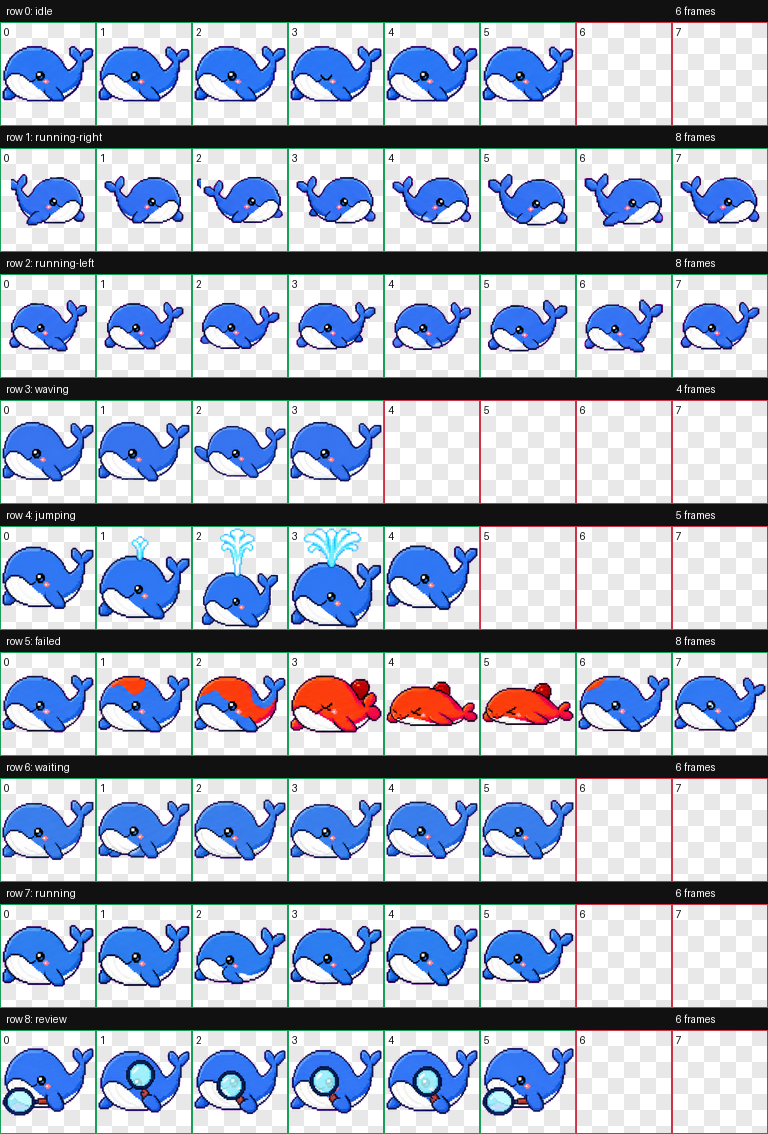
- A QA-validated 8×9 atlas with fixed 192×208 cells: calm idle, directional drag movement, wave/click, connected water-spout success, red-hot fault/error, waiting, active work, and magnifying-glass search animations.
- A Codex Pet-style card above the whale showing the latest local user prompt, live/final Harness reply, and progress; long streams follow the newest text while remaining scrollable, and displayed text is never persisted.
- Dragging uses dedicated left/right swimming rows; clicking plays a short flipper wave without sprite overflow.
- Optional Chromium desktop-window mode keeps the pet visible in an always-on-top Document Picture-in-Picture window while the main Harness window is minimized.
- Draggable, viewport-clamped position saved in
localStorage. - Pet size, opacity, enable/disable, reset position, and reduced-motion controls.
- Instant, persisted interface switching between English (default), Simplified Chinese, Japanese, and Korean.
- Debug state override, automatic state cycling, and a live status badge.
- Original pixel sprites embedded directly into the client bundle, with the procedural Canvas whale retained as a fallback.
- Full cleanup for subscriptions, timers, animation frames, media listeners, and resize listeners.
Install
Harness 0.1.0-rc.6 and pnpm on PATH are required. Installing or removing a plugin changes the host roster, so restart the dsh web process after one of these commands. A code-only rebuild of an existing link installation needs only a page refresh.
npm
The package name is reserved for a future npm release. Until it is published, use the Git or local-link installation below.
dsh plugin --profile web add harness-pet
Git
dsh plugin --profile web add github:cakeni/harness-pet
Git dependencies run this package's prepare build. If pnpm blocks that build, add the exact package key printed by the CLI to the profile's pnpm-workspace.yaml, for example:
allowBuilds:
  harness-pet: true
Then repeat the install command. The profile is normally under $DSH_HOME/profiles/web.
Local development link
Run this from the repository's parent directory:
dsh plugin --profile web add link:../harness-pet
Build and refresh during development:
cd harness-pet
pnpm bundle
Do not run more than one link installation for the same profile.
State detection
The adapter subscribes to the current ctx.sessions list and SessionFace snapshot. It also observes ctx.connection.hostDescription; after a connection has existed, that structured value becoming absent indicates reconnecting. It never matches translated UI text or scrapes the DOM.
Priority is: error > success > waiting > searching/bash/editing > working > thinking > idle.
| Pet state | Structured detection | Confidence | Failure degradation |
|---|---|---|---|
idle | No higher-priority signal | High | Remains idle |
thinking | partial is present and no tool is running | High | Idle if the field is absent or malformed |
working | running === true, or non-empty unknown runningCalls | High | Idle after all running signals clear |
searching | Running tool name matches the adapter's web-tool table | Medium | Unknown tool names degrade to working |
bash | Running tool name matches the adapter's shell-tool table | Medium | Unknown tool names degrade to working |
editing | Running tool name matches the adapter's file-write/editor table | Medium | Unknown tool names degrade to working |
waiting | Non-empty pending, or a queue item with placement: 'queued' | High | Falls through to the active lower-priority state |
error | promptError, latest turn-error, lastAgentError, or reconnecting | High | Falls through when the structured error clears |
success | Derived from a clean running: true → false edge for about 3 seconds | Derived | Returns to the latest real state, usually idle |
The tool-name table is intentionally isolated in src/adapters/deepseek-harness.ts. Pre-1.0 Harness releases may rename tools; an unrecognized active tool is reported only as working, never fabricated as a specialized state.
Controls
- Click the whale for a short flipper-wave interaction.
- Drag it to move it; the position is persisted locally.
- Click the gray follow-up icon to open an input. Enter submits the text to the current Harness session through its official
SessionFace.prompt(..., 'queue')method. - Close the conversation card with its
×button when it gets in the way. It stays closed for the current session; use Show Dialog in settings to restore it. A different session opens the card again. - Double-click, long-press, or use the gear button to open settings. Drag the settings title bar to move that panel independently of the whale.
- Choose Language in settings to switch all pet controls, status text, dialog prompts, and desktop-window messages immediately.
- When Open Floating Pet is enabled in settings, the main Harness window may be minimized while the pet remains in its independent always-on-top window. The Harness tab and browser process must remain open.
- If the pet is disabled, the gear remains at the lower-right so it can be enabled again.
- Debug State can follow Harness or force any visual state. Auto-cycle rotates through all nine states.
Both the operating-system prefers-reduced-motion: reduce preference and the manual Reduced Motion setting stop continuous animation while retaining the correct static state.
Privacy
No telemetry. Harness Pet sends no conversation data to any third party.
The plugin makes no independent fetch, analytics, telemetry, cloud-sync, or third-party request. It reads the minimum structured fields needed to render the latest local user prompt and Harness reply. Displayed conversation text is never persisted. Only when you explicitly submit the follow-up input is that text delivered to the current Harness session through Harness's existing official transport. Only settings are stored in browser localStorage; the plugin asks for no browser permissions.
Compatibility
| Harness client API | Status |
|---|---|
0.1.0-rc.6 | Targeted and type-checked against the published client contracts |
Later 0.1.x prereleases | Unverified; the client API is pre-1.0 and may change |
| Browser extension mode | Unsupported; this project is a native DSH plugin |
| Desktop window | Chromium 116+ Document Picture-in-Picture; unsupported browsers keep the control disabled |
All Harness coupling is kept in the adapter so API updates have one repair point.
Development and tests
pnpm install
pnpm run typecheck
pnpm test
pnpm bundle
The bundle must start with a window.__ModuleLoader__.load registration for harness-pet and export { apply, inject } from its factory.
Automated tests cover the state mapper and priority, success transitions and timeout, unknown-signal degradation, corrupt storage, singleton reuse, and subscription/timer cleanup. Loading inside a real Harness page, drag behavior, visual animation, SPA navigation, and long-running leak checks still require manual browser verification.
Manual verification
After installing and restarting dsh web yourself:
- Confirm
window.__DSH_BOOT__.entriescontainsharness-pet. - Confirm
/plugins/harness-pet/client.jsreturns HTTP 200. - Confirm the whale and its card render without console errors, the card shows the latest local prompt plus streaming/final reply, and every Debug State is distinct.
- Open the gray follow-up input, send a test message, and confirm it appears in the current Harness session; also verify an admission failure keeps the draft and shows an error.
- Test dragging, reload position persistence, enable/disable, size, opacity, and reset.
- Enable reduced motion at OS and panel levels and confirm continuous motion stops.
- Open Desktop Window, minimize the main Harness window, and confirm the pet stays visible; close it and confirm the pet returns to Harness.
- Navigate between sessions and SPA routes, then refresh; confirm only one pet exists.
- Run a real search, shell command, edit, pending interaction, successful turn, error, and reconnect where available.
- Leave the page open for an extended session and check that subscriptions and timers do not accumulate.
Replacing or adding artwork
The current 8×9 animation atlas is embedded into client.js, so the plugin performs no asset request at runtime. It uses fixed 192×208 cells and transparent unused slots; semantic effects are connected to the whale and remain inside their frame—water from the blowhole, a magnifier held by the flipper, and red-hot fault coloring. To replace or add a sprite:
- Add authorized expression/state files under
assets/whale/. - Record its source, author, and license in
assets/whale/ATTRIBUTION.md. Unregistered assets must not be distributed. - Bundle the bytes into
client.js(for example as an imported data URL) instead of fetching a remote URL at runtime. - Keep the procedural draw path as the fallback and verify reduced-motion behavior.
Never download or include artwork of unknown provenance.
License
보안 및 설치 증거
이 점수는 공개 저장소 메타데이터와 이 사이트에 등록된 설치 증거에만 기반하며, 코드 보안 감사와 다릅니다.
공개 플러그인 카탈로그에서 왔으며, 공개 GitHub 저장소로 연결됩니다.
저장소가 MIT 라이선스를 선언했습니다.
최근 180일 내 코드 업데이트가 있습니다.
재현 가능한 정확한 설치 메타데이터가 아직 등록되지 않았습니다. 저장소 설명에 따라 직접 확인하세요.
검사한 패키지 메타데이터에 설치 라이프사이클 스크립트가 선언되지 않았습니다.