
OpenAI Codex Provider
OpenAI Codex provider for DeepSeek Harness
이것은 DeepSeek Harness(DSH) 플러그인입니다. 이 사이트는 GitHub README, 설치 정보, 유지보수 상태, 공개 보안 시그널을 모아 보여줍니다.
업스트림에서 중국어 README를 제공하지 않아 저장소 원본 내용을 표시합니다.
@jcy2387/dsh-codex-provider-plugin
English | 中文
An independently published OpenAI Codex provider for DeepSeek Harness, installable with dsh plugin add. It uses ChatGPT OAuth, registers openai-codex through the native Harness LLM service, and adds browser and device-code sign-in controls to the Web Settings UI.
This package does not modify the deepseek-harness source tree and does not run Codex as a subagent. Codex models use the normal Harness agent loop, tools, permissions, sessions, streaming, and compaction pipeline.
This plugin uses pi-ai's
openai-codexprovider to access the ChatGPT Codex backend. It is not an OpenAI Platform API-key integration. OpenAI controls endpoint behavior, model availability, and quotas, which may change. Use it only in ways permitted by your account and applicable terms.
Architecture
One npm package ships two runtime faces:
- Host: registers the
openai-codexLLM adapter, stores OAuth state through the Harness credential provider, fetches account usage, and exposes a plugin-owned, loopback-only Connection RPC. - Browser: loads through the
dsh.clientmanifest and registers a native Settings page. It receives only validated, secret-free authentication and usage snapshots; tokens and account ids never enter the browser.
Harness currently exposes Settings sections as a flat list and the Models page has no external content slot. The plugin therefore stays on an independent OpenAI Codex page ordered immediately after Models, rather than patching Harness or injecting brittle DOM content.
cordis.patch.yml inserts one self-owned plugin row. The package neither imports nor modifies @deepseek-ai/dsh-api-remotes, so installation requires no static Remote registration in Harness.
Model ids, contextWindow, and maxTokens come directly from pi-ai's Codex catalog. Harness reads them through its normal ctx.llm.resolveModelInfo() path, so session context budgets and automatic compaction need no provider-specific integration.
Install from npm
dsh plugin --profile web add @jcy2387/dsh-codex-provider-plugin
dsh web
Set up OpenAI Codex
This plugin uses ChatGPT OAuth, not an
OPENAI_API_KEYor OpenAI Platform API key.
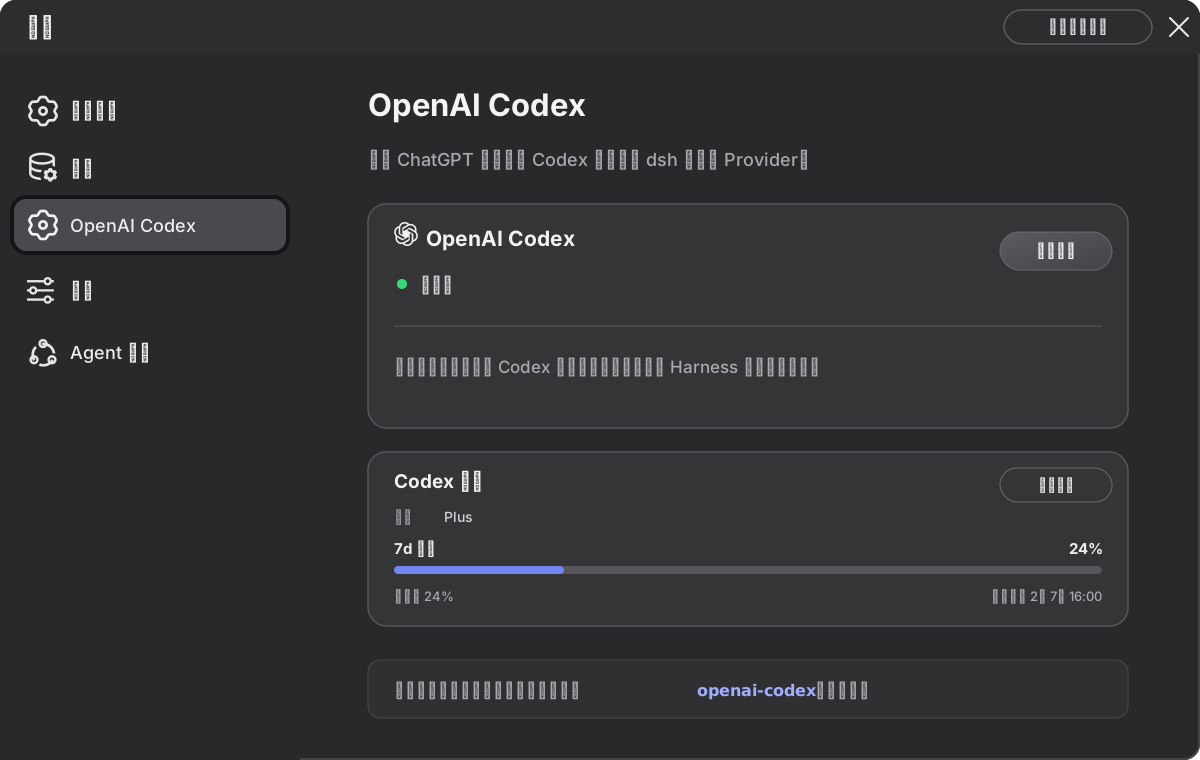
The settings page looks like this:
- Start the Web UI with
dsh web. - Open Settings → OpenAI Codex and click Connect Codex.
- Choose Browser sign-in and authorize with your ChatGPT account, or choose Device code sign-in for a headless/remote Host.
- After the status becomes Connected, the page displays the usage windows currently returned by OpenAI and refreshes them every 60 seconds. Removed or unavailable windows are not shown; no five-hour limit is hardcoded.
- Select a model under
openai-codexin the normal model picker. Installing the plugin does not change the default model.
Browser sign-in requires the browser and dsh Host to run on the same machine. Device-code sign-in may need to be enabled in ChatGPT security settings or workspace permissions. Your account or workspace must have Codex access; model availability and quotas are controlled by OpenAI. Usage comes from OpenAI's account-scoped ChatGPT endpoint and may change with that service.
Upgrade
Plugins are installed independently for each dsh profile. Upgrade this plugin in the web profile to the newest published version:
dsh plugin --profile web update @jcy2387/dsh-codex-provider-plugin --latest
To install an exact version instead:
VERSION="$(npm view @jcy2387/dsh-codex-provider-plugin version)"
dsh plugin --profile web add "@jcy2387/dsh-codex-provider-plugin@$VERSION" --save-exact
Verify the installed version, restart dsh web, and force-refresh the browser so it does not reuse the previous client bundle:
dsh plugin --profile web list @jcy2387/dsh-codex-provider-plugin --depth 0
When running from a deepseek-harness source checkout, prefix these commands with pnpm.
Local development installation
pnpm install
pnpm run check
dsh plugin --profile web add link:/Users/baojie/Documents/Projects/github/dsh-codex-provider-plugin
dsh web
From a deepseek-harness source checkout, prefix the last two commands with pnpm:
pnpm dsh plugin --profile web add link:/Users/baojie/Documents/Projects/github/dsh-codex-provider-plugin
pnpm dsh web
Open Settings → OpenAI Codex, then choose browser sign-in or device-code sign-in. Installation only adds a provider; it does not change the default model. Select a model under openai-codex through the normal model picker.
Configuration
Every field is optional:
- id: llm-openai-codex
  config:
    credentialRef: OPENAI_CODEX_OAUTH
    transport: auto
    streamIdleTimeoutMs: 300000
    ipv6CallbackBridge: true
    proactiveRefresh: true
credentialRef: reference used by the Harness credential provider for serialized OAuth state.transport:sse,websocket,websocket-cached, orauto.timeoutMs: provider request timeout.websocketConnectTimeoutMs: WebSocket connection timeout.streamIdleTimeoutMs: maximum idle interval while waiting for the next stream chunk.retryPolicy: standard Harness LLM retry configuration.ipv6CallbackBridge: temporarily bridge[::1]:1455to pi-ai's127.0.0.1:1455listener during browser sign-in. Enabled by default; disable it whenPI_OAUTH_CALLBACK_HOSTis explicitly managed by the deployment. The IPv4 port-availability check remains active when only the bridge is disabled.proactiveRefresh: refresh the access token in the background a few minutes before it expires, so the first request after expiry never pays the token round-trip. Enabled by default; disable it to fall back to purely lazy, request-driven refresh.
Token refresh
pi-ai rotates expired access tokens under a double-checked credential lock, and the plugin persists every rotated credential back into the Harness credential store. Two behaviors sit on top of that:
- Proactive refresh: while connected, the Host refreshes the access token five minutes before expiry. Transient network failures retry after one minute, then every five minutes, without changing the sign-in state.
- Failure surfacing: if OpenAI rejects the refresh token (for example
invalid_grant), the Settings status flips to Sign-in expired with a reconnect action instead of failing requests silently. Any later successful refresh — from the timer or from a request — flips the state back to Connected automatically. Refresh errors stay in the Host log; only the secret-free state crosses RPC.
Authentication troubleshooting
The Settings UI reports a stable diagnostic code without returning OAuth responses or tokens to the browser:
| Code | Meaning and next check |
|---|---|
CODEX_AUTH_ACCOUNT_ACCESS | OpenAI did not issue usable Codex credentials. Check MFA, the selected ChatGPT workspace, and workspace Codex permissions. |
CODEX_AUTH_BROWSER_CALLBACK | Authorization did not reach the Host. Run the browser on the Host machine and check whether localhost:1455 is blocked or occupied. The default IPv6 bridge handles systems that resolve localhost to ::1. |
CODEX_AUTH_DEVICE_CODE_DISABLED | Enable device-code sign-in in personal ChatGPT security settings or workspace permissions. |
CODEX_AUTH_NETWORK | Check the Host's proxy, DNS, TLS trust, and firewall access to OpenAI authentication services. |
CODEX_AUTH_TOKEN_EXCHANGE | Authorization returned but credential exchange failed. Retry, then check the Host clock and proxy. |
CODEX_AUTH_UNSUPPORTED_REGION | Browser authorization completed, but the Host network exits from a country or region OpenAI does not support. Use a Host network that complies with OpenAI availability and terms, then start a new login. |
CODEX_AUTH_UNKNOWN | Test official Codex sign-in on the same Host to separate an account/environment failure from a plugin compatibility issue. |
Browser sign-in redirects to http://localhost:1455/auth/callback, so it is suitable only when the browser and dsh Host run on the same machine. Before starting pi-ai, the plugin verifies that 127.0.0.1:1455 is available and fails immediately with CODEX_AUTH_BROWSER_CALLBACK when another process owns it. While browser login is active, it also opens an IPv6-only [::1]:1455 listener that redirects the exact callback path and query to pi-ai on IPv4, then closes it when the attempt ends. It never listens on a LAN address. Full provider errors stay in the Host log; the browser receives only the diagnostic codes above. For a headless Host, use device-code sign-in after enabling it for the account or workspace. See OpenAI Codex authentication.
Current scope
The plugin includes the provider, OAuth lifecycle, native Settings UI, model catalog, compaction metadata, and Codex usage display. The Host calls https://chatgpt.com/backend-api/wham/usage with the refreshed OAuth credential, validates the response, and sends only plan, window percentages, reset timestamps, and optional credit balance over its loopback-only RPC. The UI renders only windows present in the response, so it does not assume a five-hour limit.
Development
pnpm install
pnpm run typecheck
pnpm test
pnpm run build
pnpm run publint
Build outputs:
lib/index.js: Host plugin.lib/client.cjs: loader-compatible browser plugin with inline CSS Modules.lib/types/**: Host and browser declarations.cordis.patch.yml: profile layer activated by thedsh.bundlemanifest.
보안 및 설치 증거
이 점수는 공개 저장소 메타데이터와 이 사이트에 등록된 설치 증거에만 기반하며, 코드 보안 감사와 다릅니다.
공개 플러그인 카탈로그에서 왔으며, 공개 GitHub 저장소로 연결됩니다.
저장소가 MIT 라이선스를 선언했습니다.
최근 180일 내 코드 업데이트가 있습니다.
재현 가능한 정확한 설치 메타데이터가 아직 등록되지 않았습니다. 저장소 설명에 따라 직접 확인하세요.
검사한 패키지 메타데이터에 설치 라이프사이클 스크립트가 선언되지 않았습니다.