
Agent 消息互发
Cross-session agent-to-agent messaging for DeepSeek Harness.
이것은 DeepSeek Harness(DSH) 플러그인입니다. 이 사이트는 GitHub README, 설치 정보, 유지보수 상태, 공개 보안 시그널을 모아 보여줍니다.
업스트림에서 중국어 README를 제공하지 않아 저장소 원본 내용을 표시합니다.



dsh-agent-messaging
Cross-session agent-to-agent messaging for DeepSeek Harness.
Two sessions you started yourself — in the Web UI, in a headless run, in separate
worktrees, in separate dsh processes — cannot tell each other anything. When one
discovers a breaking change the other is about to trip over, you are the transport:
you read it in one terminal and retype it in the other.
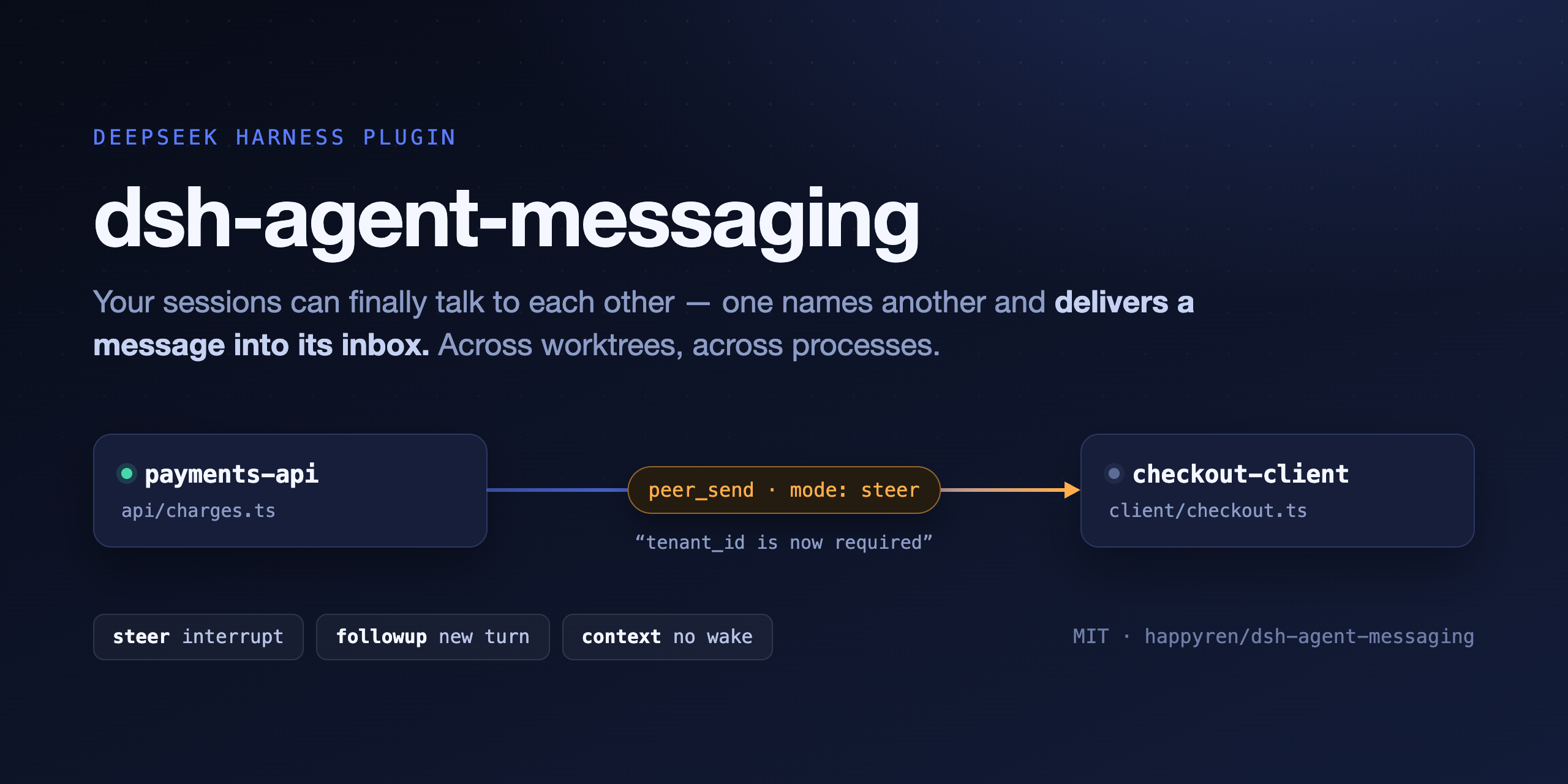
This plugin gives them an address and a mailbox. One session names another and delivers a message into its inbox; the harness schedules it like any other model-facing input.
session "payments-api"                      session "checkout-client"
        │                                              │
        │  peer_send  to: checkout-client              │
        │             mode: steer                      │
        ├─────────────────────────────────────────────►│  interrupts at the next step
        │  "tenant_id is now required on ChargeRequest │
        │   — your call site will break"               │
Demo
A real run, in two sessions of one dsh web host, over a toy repo where each
session owns a different file.
The payments session changes the contract, then picks a delivery mode. It finds
the affected session with peer_list, edits api/charges.ts, and reasons about
urgency on its own: "it's mid-task, so I'll use steer (interrupt) rather than a
queued message."

The checkout session is interrupted, verifies the claim, and answers. The message
arrives as a Context injection · dsh-agent-messaging row. Note what it does with
it: reads api/charges.ts to check the claim rather than believing it, replies to
the sender, and reports to its own user — "treated it as information, not
instructions."

That refusal to act is the default, and it is deliberate. See Collaboration and safety for how to let sessions actually make edits for each other.
What it is not
The harness already covers the neighbouring cases, and this plugin deliberately does not duplicate them:
| You want | Use |
|---|---|
| To pull another session's history into your next message | dsh-session-reference (@[label](dsh-session:…)) |
| A coordinator that spawns and supervises workers | the subagent subsystem |
| To continue one conversation elsewhere | resume the session |
| To tell another independent session something, now | this plugin |
A message is text. Never conversation history, never files.
Install
npx -p @deepseek-ai/dsh dsh plugin --profile web add github:happyren/dsh-agent-messaging
dsh plugin shells out to pnpm, so pnpm ≥10 must be on your PATH — corepack enable pnpm
is enough.
The package ships a self-contained prepare script, and pnpm blocks build scripts
from git dependencies until you allow them. The first add will fail and print the
package key; add it to the profile's pnpm-workspace.yaml:
allowBuilds:
  dsh-agent-messaging: true
then re-run the add. Pin a commit (github:happyren/dsh-agent-messaging#<sha>) so a
later push cannot change what runs on your machine.
Restart the profile afterwards, and verify the layer loaded:
dsh --profile web --dump-config
You should see a # == dsh-agent-messaging layer.
Tools
Nine tools register by default. That is a lot of competition for a model's attention, so a deployment only pays for what it uses:
- id: agent-messaging
  config:
    capabilities:
      claims: true         # peer_claim
      verification: false  # peer_verify, peer_verify_reply
      identity: false      # peer_card, peer_status
      decisions: false     # peer_decide, peer_decisions
That leaves three: peer_list, peer_send, peer_claim. Addressing and delivery
are always registered — without them nothing else has a point. Everything defaults
on, so upgrading never silently removes a tool a workflow depends on.
peer_inbox registers only under inbound: hold, because held messages do not
exist otherwise and a tool that always reads an empty list is pure overhead.
peer_list
Sessions this one can address — name, state, title, directory. Identities only; never their contents.
checkout-client [idle] "Wire up checkout submit" — /repo/test-project
payments-api [running] "Add tenant_id to charges" — /repo/test-project
Names come from each session's folded title, falling back to its directory, then its id, and are collision-disambiguated — so an address you read in one listing still resolves in the next.
peer_send
Deliver one message. The sender's identity comes from the executing agent, so a model cannot send a message claiming to be another session.
mode | Arrives | Use for |
|---|---|---|
steer | At the receiver's next step boundary, interrupting it | Something that makes its current work wrong |
followup (default) | As its own later turn | The ordinary handoff |
context | Folded into whatever it does next, without waking it | Background it should know but need not act on |
These map onto Agent.steer(), Agent.followup() and Agent.inject() — the inbox
boundaries the harness already owns. Choosing is the sender's job, because only the
sender knows whether the news invalidates work already in progress.
A session that is not running still accepts messages: they are spooled and delivered when it next starts, within the configured age and depth bounds.
Replies correlate through reply_to, and the receiver is told to answer the sender's
session id rather than its display name, which can change when a title is refolded.
Groups. Address #backend to reach a whole set at once. Membership is declared
on each session's peer_card, and the shape is an operator decision in config —
because denser is not automatically better and every extra recipient costs a turn:
- id: agent-messaging
  config:
    groups:
      backend: { topology: star, lead: tech-lead }
    maxFanout: 8
mesh reaches everyone; star routes a member's message to the lead alone and lets
the lead broadcast — one message in costs one turn instead of N. Each recipient is
an ordinary send, so inbound policy, loop control and accounting apply per
recipient: a group address is a convenience for the sender, never a way around the
receiver.
Configure the lead against a session's alias (peer_card alias: "tech-lead"),
not its display name — display names are folded from session titles and move.
peer_decide and peer_decisions
Record what was settled, so a session that starts later doesn't reopen it.
peer_decisions  about: "api/charges.ts"
→ 2026-08-14 13:58 · record-billing-decisions [api/charges.ts]
    currency stays hardcoded to "usd" for now; multi-currency deferred until
    billing supports it
    why: billing does not support multi-currency yet
    id: 4f2a…
Messages are ephemeral — delivered once, folded into a transcript, gone when that session compacts or ends. Common ground has to outlive them, which needs a record rather than a conversation. This targets FM-1.4 loss of conversation history and FM-2.1 conversation reset.
It's the transactive-memory direction: rather than replicating every session's context into every other, publish the small durable index of conclusions and let peers query it by area. A directory covers what's beneath it, same nesting rule as claims and ownership.
Nothing is ever edited or deleted — decisions are superseded. A later decision
names the one it replaces; peer_decisions returns only what's in force, so
nobody acts on a reversed decision, and include_superseded shows the history.
peer_status
Say what your work is doing — working, blocked, done, abandoned — and
find out if you have just deadlocked.
peer_status  phase: "blocked"  blocked_on: "payments-api"
             summary: "need the charge schema finalised"
→ published: blocked
  DEADLOCK — you are in a mutual wait:
  checkout-client → payments-api → checkout-client
  Nobody in this cycle will proceed on their own. Break it: message one of them
  with peer_send, do the part you can without waiting, or ask your user to decide.
The agent registry already reports idle/running, but that describes a
driver, not a task. A session is idle both when it has finished and when it
is waiting on a peer — indistinguishable from outside, and the difference is
exactly what a peer needs to decide whether to wait.
This targets FM-1.5 unaware of termination (12.4%) and FM-3.1 premature termination (6.2%), and is common ground in Klein's sense — a teammate that cannot signal completion or blockage cannot be coordinated with.
Because blocked carries who it is blocked on, a mutual wait becomes
representable and therefore detectable. The check runs when a session declares
itself blocked, which is the moment a cycle can first close. Without it a
deadlock is silent: every participant looks merely idle, nobody is finished, and
nothing reports it.
peer_card
Declare what this session is for and what it owns, so peers route work correctly instead of guessing from a folded title.
peer_card  role: "Payments API owner. I do NOT own client code."
           owns: [{ resource: "api/charges.ts" }, { resource: "charge validation rules", scope: "topic" }]
           skills: ["payments-api", "validation-rules"]
It then appears in every peer's peer_list, and a session with work to route
reads it rather than guessing.
This targets FM-1.2 disobey role specification and FM-2.3 task derailment (7.4%); role specification was one of only two interventions MAST measured directly, at +9.4%. Shaped after A2A Agent Cards so the same declaration can later serve cross-vendor discovery.
Ownership here is standing responsibility, not a reservation — it never
conflicts and reserves nothing. peer_claim is the short-lived "I am editing this
right now" signal. Saying what you don't own is as useful as what you do, since
it stops peers sending you work that isn't yours.
peer_verify and peer_verify_reply
Ask a differently-situated peer to check a claim you're about to act on.
peer_verify  to: "payments-api"
             claim: "createCharge rejects a blank tenant_id"
             evidence: [{ locator: "api/charges.ts", at: "12", note: "the guard" }]
The peer is told to check, not agree — "go and look before answering; do not
take the claim on trust" — and replies with a typed verdict: confirmed,
refuted, inconclusive, or declined, plus what it actually examined.
This targets MAST's task-verification category (24.5% of failures) and is the intervention with its largest measured gain (+15.6%). It belongs in a messaging plugin rather than an agent's own loop because self-verification is known to fail — a model largely cannot check its own reasoning. A peer is a different verifier in the way that matters: it didn't produce the artefact, so it has to go and look.
A refuted verdict comes back as a steer, because the asker is probably acting
on the claim right now and a queued turn would arrive too late.
peer_claim
Announce what you are working on, and find out whether a peer is already on it.
peer_claim  resource: "client/checkout.ts"  intent: "threading tenant_id through"
→ refused: overlaps a claim held by another session.
  checkout-client holds "client" — refactoring the submit path (expires in ~24 min)
  Message the holder with peer_send instead of working in parallel.
This targets the largest single failure mode in the MAST taxonomy: step repetition, 15.7% of observed multi-agent failures — whose concrete instance in coding is two sessions editing the same file, or re-deriving what a sibling already knows.
Path claims nest, so holding client covers client/checkout.ts, and sibling
names never collide (src/app does not contain src/apple). Topics don't nest.
Claims expire on their own, and are dropped when the holding session ends.
Claims are advisory, not locks. The plugin cannot stop another process
writing a file, and a lock that can't be enforced is worse than an honest hint —
it invites callers to skip the check they'd otherwise make. Claimed resources
show up in peer_list under working_on.
peer_inbox
Lists messages held for you under the hold policy, and releases them when your
operator asks. Empty under the default accept.
Collaboration and safety
By default a peer message is information, not instruction. The receiving model is told it may act on a request inside it only if its own user asks. That is the right default between two sessions that merely happen to share a machine, and the wrong one between two sessions you are deliberately running as a pair.
peerAuthority and trustedPeers change that, per receiving session:
- id: agent-messaging
  config:
    peerAuthority: act
    trustedPeers:
      - payments-api
With this, a message from payments-api is framed as coming from a peer the operator
has authorised, and the receiver may act on it directly. Everything else still arrives
as information.
Three properties worth being precise about, because the setting is easy to over-read:
- It is prompt-level, not enforcement. It changes what the receiving model is told. The enforcement boundary is the receiving session's own permission rules, access mode, and sandbox — identical at every authority level.
- It grants nothing. At both levels the message is explicitly unable to approve an action, grant a permission, or change configuration. Those are the operator's to give, and no setting delegates them. An authorised peer that asks for something outside the receiver's existing permissions is refused.
- Raising the level alone does nothing.
trustedPeersis empty by default and matched exactly, so a session that appears later never inherits standing it was never granted, and a lookalike name (payments-api-staging) does not matchpayments-api.
For work that should stay under human control, prefer inbound: hold — messages
wait, and peer_inbox releases them when you say so.
Is it paying for itself?
Every feature here is justified by someone else's measured failure rates. None is justified by yours — so the plugin counts what it cost and what it caught:
npm run report            # all recorded activity
npm run report -- --days 7
COST — turns this plugin caused a session to spend
  messages delivered              12
  dropped by loop control          2
CAUGHT — what would otherwise have gone wrong
  collisions avoided               3   (a peer already held the resource)
  false claims caught              1   (verification refuted them)
  deadlocks detected               1

12 receiver turns spent, 5 problems caught.
Deliberately framed as cost versus catch, not usage counters: "42 messages
sent" says nothing, while "42 receiver turns spent, 6 collisions avoided" is a
judgement you can actually make. Counts are local and aggregate — no message
content is stored — and metrics: false turns recording off entirely.
This is a command rather than an eleventh peer_* tool on purpose. The audience
is you, deciding whether the plugin earns its turns; putting it in front of the
model would take attention from the ten tools that do the work.
The report states its own limit at the bottom, and means it: a caught collision is a real save, but these counts cannot tell you whether the turns spent were worth it.
Reaching agents outside DSH
Configure an Agent2Agent endpoint and
it becomes an ordinary peer — it shows up in peer_list and accepts peer_send:
- id: agent-messaging
  config:
    a2aEndpoints:
      reviewer: { url: "https://reviewer.example/a2a", token: "…" }
A2A is the agent-to-agent standard worth building against — Google donated it to the Linux Foundation, with AWS, Cisco, Microsoft, Salesforce, SAP and ServiceNow among the founding members — and it complements MCP rather than competing: MCP connects an agent to tools, A2A connects agents to each other.
Two boundaries worth knowing:
- External senders are never elevated. A2A cannot express authority
scope, so an external agent is always
inform, whateverpeerAuthoritysays and whatever it claims about itself. Trust is a property of your configuration, not of a field a stranger can set. - Outbound only. DSH sessions can reach out; external agents cannot reach in. Serving an Agent Card needs an HTTP surface and its own authorization story, and shipping half of that would be worse than shipping none.
Endpoints must be https, or localhost for local development. A misconfigured
endpoint is logged and skipped — local messaging keeps working.
How it reaches another process
One dsh host holds many sessions, so discovery and delivery split:
- Discovery reuses
ctx.sessionQuery, which already merges the live store with the persistence backend and reports both availabilities. The plugin adds only the fact that service cannot know — which other host process currently holds a session. - Delivery is a direct call when the recipient is a live agent in the same
process; otherwise it crosses a per-host Unix domain socket, discovered through
advisory presence records under
$DSH_HOME/agent-messaging/hosts/. Records whose process or socket is gone are pruned on sight.
Both routes converge on the same admission path, so a receiver's policy cannot be bypassed by happening to share a process with it.
Configuration
Override in your profile's cordis.patch.yml:
- id: agent-messaging
  config:
    inbound: accept
    spoolOffline: true
| Key | Default | Meaning |
|---|---|---|
inbound | accept | accept, hold (await operator release), or refuse |
peerAuthority | inform | act lets authorised peers be acted on directly |
trustedPeers | [] | Peers authorised by peerAuthority: act, matched exactly |
stateRoot | $DSH_HOME/agent-messaging | Presence records and the offline spool |
includeSubagents | false | Make subagent children addressable |
spoolOffline | true | Hold messages for sessions that are not running |
spoolMaxAgeMs | 86400000 | Discard a spooled message older than this |
spoolMaxPerSession | 20 | Spool depth per recipient |
rateMaxPerWindow | 10 | Messages one sender may deliver per window |
rateWindowMs | 60000 | Rate window |
duplicateWindowMs | 30000 | Identical bodies dropped inside this window |
maxHeld | 100 | Held messages retained per session |
deliveryTimeoutMs | 5000 | Wait for a peer host's receipt |
To stop receiving entirely, set inbound: refuse. To stop sending, deny the tools in
your permission rules.
Security model
A peer is another agent, not your operator, and the plugin is built so that distinction survives contact.
- Inbound messages are framed as untrusted. Every delivery carries a fixed warning describing what the block is and what it cannot do. This follows the convention the harness established for cross-session references.
- A body cannot forge its own frame. The data region is JSON with every
<emitted as its lossless JSON unicode escape, so no peer-supplied string can spell the surrounding tags and escape into the instruction area. - Senders cannot be impersonated. Identity is read from the executing agent, never from tool arguments.
- Loop control terminates runaways. Per-sender rate limiting and duplicate suppression mean two agents that answer each other automatically stop on their own.
- The inbox is owner-only. The socket is
chmod 0600; on a shared machine another user's processes cannot reach it. - Wire input is validated before it reaches policy. Unknown protocol versions, wrong types, oversized bodies and oversized frames are rejected at the boundary.
Permission boundaries stay per-session: an arriving message never answers a pending prompt, and anything it asks for is still subject to the receiving session's own rules.
Limitations
- Same machine only. Delivery is by Unix domain socket, so two sessions can reach each other only when they share a filesystem. A container and its host cannot; two sessions inside one container can.
- Plain text only. No structured payloads, no attachments.
- Spooled messages are best-effort. They expire, and the deepest are dropped first.
- Presence is advisory. A host that dies between publishing and delivery makes a session look reachable until the record is pruned.
- The harness is a developer preview with no compatibility promise. This builds
against the npm
rcline; service keys have been renamed between releases before, so re-verify after a harness upgrade.
Development
npm install
npm run verify   # typecheck, tests, build
The layering keeps policy testable without a running harness: src/domain is pure and
imports no framework, src/app holds the use cases behind the interfaces in
src/ports, and src/adapters binds those to Cordis, the agent registry, sockets and
disk.
tests/scenario.integration.test.ts is the one that proves the README's actual
claim. It runs a three-session team through a breaking contract change on the real
stack — real stores, real sockets, real loop control, real accounting — and pins
the exact numbers that come out:
3 receiver turns spent, 3 problems caught
  collisions avoided   1   checkout stopped from duplicating a claimed file
  false claims caught  1   a currency claim refuted before it was acted on
  deadlocks detected   1   docs and checkout waiting on each other
It also pins the guarantee the admission design rests on: a refuse policy holds
whether a message arrives in-process or over a socket. If a change makes
collaboration quieter or noisier, those numbers move and the test says so.
Transport, presence and spool tests run against real Unix sockets and real files rather
than mocks. tests/collaboration-scenario.test.ts drives the handoff shown above end
to end.
docs/design.md covers why each seam is where it is, and which
alternatives were rejected. docs/roadmap.md is the research
note behind what gets built next: what the multi-agent literature actually shows
(including that agent debate usually loses at equal token budget), which
measured failure modes each planned feature attacks, and what is deliberately not
being built.
Contributing
Code contributions are not being accepted, but questions, bug reports and ideas are welcome in Discussions. See CONTRIBUTING.md.
License
MIT © Kaixiang Ren
보안 및 설치 증거
이 점수는 공개 저장소 메타데이터와 이 사이트에 등록된 설치 증거에만 기반하며, 코드 보안 감사와 다릅니다.
공개 플러그인 카탈로그에서 왔으며, 공개 GitHub 저장소로 연결됩니다.
저장소가 MIT 라이선스를 선언했습니다.
최근 180일 내 코드 업데이트가 있습니다.
재현 가능한 정확한 설치 메타데이터가 아직 등록되지 않았습니다. 저장소 설명에 따라 직접 확인하세요.
검사한 패키지 메타데이터에 설치 라이프사이클 스크립트가 선언되지 않았습니다.